Viability-based control of a planar hopper
Classically, a legged robot is said to achieve stable locomotion if it converges toward a periodic limit cycle. For the simple hopper, this means achieving a constant velocity hopping gait.
However, more complex motion such as changing the direction or velocity are non-periodic. For such motion, there might be none or several limit cycles and the classical approach no longer provides garantees that the robot will not fall over.
Our approach consists in rendering a subset of the viability kernel invariant. Inside this set, the robot is garanteed to never fall. Controlling the robot consists in matching the desired velocity as close as possible under the constraint of remaining viable. The robot below is controlled using keyboard inputs (illustrated by the green arrow) in real time.
No periodicity constraint is imposed. However, when the desired velocity is constant and the controller aims at minimizing the mechanical power outputed, limit cycles naturally arise.
Future works: extension with virtual constraints
So far we have shown that when its dynamic is simple enough, a legged robot can be controlled using the viability kernel. Now the question is how do we simplify the dynamics of a complex robot without losing the potential for agile motion?
The hybrid zero dynamics (HZD) framework
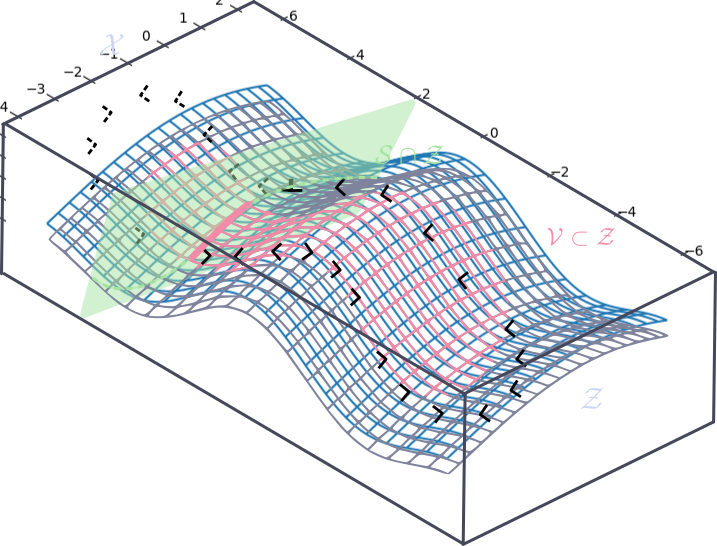
Virtual constraints can be imposed on a robot using the available actuators. Formally, it consists in rendering a low dimension subset of the state space invariant via partial feedback linearization. In addition, the system must behave nicely at impact, which is modelled as the crossing of a surface.
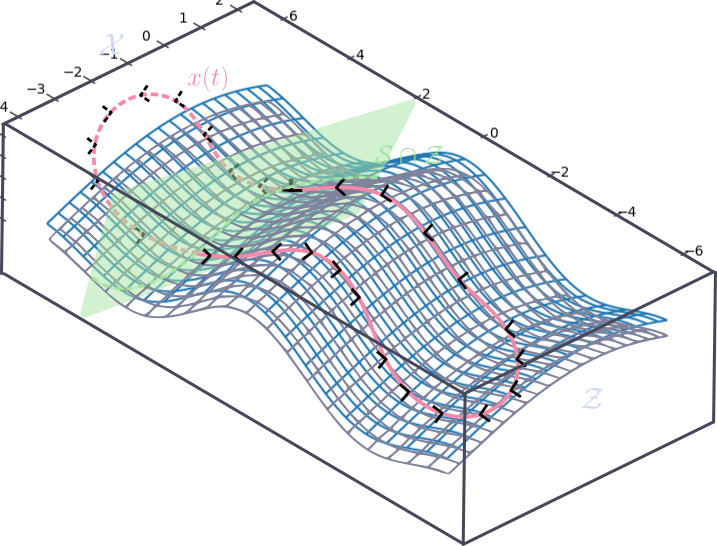
We start from a known limit cycle. This is done via a simple feedback, imposing a symmetric behaviour for the legs and a constant leaning angle of the torso.
We then add tunable constraints between the stance leg, the torso and the swing leg. Constraints are optimized to minimize the cost of transport (i.e. the energy cost of a step). This enables the emergence of efficient motion: in other words motion which exploits the passive dynamics at its maximum. For example: the walker below swings his leg later than the one with simple symmetric gait to better use the inertia of the leg.
My proposition
I propose to build from the hybrid zero dynamics theory. Instead of designing a limit cycle at the zero dynamics level, we let the zero dynamics exist inside a set contained in the viability kernel. This relaxes the requirement for periodic gaits and enables more general motion.
Rerefence
Westervelt, Eric R., Jessy W. Grizzle, Christine Chevallereau, Jun Ho Choi, and Benjamin Morris. Feedback control of dynamic bipedal robot locomotion. CRC press, 2018.